“Then came April…Nature in that month sheds rays of enchanted light which, from the sky and the clouds, from trees, meadows, and flowers, pierce to the heart of man.” – Les Miserables
It is April. I have waited a long time for April to roll around; about 11 months come to think of it. And I remember the first time that I realized I liked April; it was four years ago and I was living in Washington DC, about eight blocks behind the capitol building. It had been cold, bitterly cold, a variety of cold that I had yet to experience until that point. I vividly remember standing on the Mall, mouth agape as I watched people in business suits skiing down the mall toward the capitol. Then as suddenly as the cold had come, it was gone, and the heartless cold gave way to warmth and life. It was as if creation itself was waking from hibernation and spreading its wings, flooding my world with light. I don’t mean to be melodramatic but that’s how it seemed, my time in DC was difficult, and the weather changing was a profound event. So here we are again, April, and things in Cheongju are warming up. I walked outside the other day and found the dead trees lining the road had changed their allegiance, instead of perpetuating the icy theme of winter their dead limbs had miraculously sprouted life, green buds springing up in mutiny against their former cold master. I am convinced that simple things like that are far underrated. How can you not feel uplifted as you find yourself caught up in such a transformation, literally watching the death of one thing giving life to another? It goes beyond simple transformation, I think the proper word might be birth.
Speaking of birth, one of my best friends and his wife just had their first child. His name is Enoch, and he is as beautiful a child as I have ever seen. Let me tell you that to miss this child’s birth was difficult, I love my friend and his wife and to miss such an important occasion seemed irresponsible at best, perhaps criminal at worst. So in an attempt to rectify the situation, I was constantly skyping with my friend while he and his wife were at the hospital. I got to know the nurses as they came and went, and even serenaded Enoch with a few licks from the guitar before he was born. After 20 some hours Enoch was born, and I missed it, barely. I called my friend’s cell as I was walking out of class, and the first thing I heard was the crying of a newly born child. Enoch had been born about 30 seconds prior to me calling. I don’t know much about those things, but for some reason tears began to form in my eyes and I found myself greatly moved. Nothing was said, nothing needed to be. Something profound had happened, something that defied the narrow constrains of language and would only be cheapened by its use. For all the value we place on language, there are places that even it cannot go. There are some emotions, some chambers of the heart best left unspoken of.
So if I had to choose a phrase to describe this time, this month, this season, it would be that everything is new. Everything is becoming new, moving toward life. Even in death something new comes. Big changes are on the horizon, big news is sure to come, life is evolving each day into something more dynamic, challenging, and profound. My most sincere hope in this season is that, as I find myself in the midst of this, that I might experience each emotion deeply. I so desire to deeply experience the pathos of this time, of this place, of these situations, and in so doing evolve into who I have it in me to be. Everything is new, and hopefully, so am I.
Friday, April 17, 2009

Saturday, March 28, 2009
Of ignorance, respobsibility, and men's bathrooms
It’s the weekend and I find myself in a funny kind of limbo, awaiting with some trepidation the oncoming week, yet doing so with a book in hand and the aroma of Kenyan Coffee around me. Where would I be without coffee shops? And I will be honest with you; I have always felt guilty when I relax, when I am not performing some kind of visible labor. I think many of you can relate. So times like this when I look at my hands and wonder why they are not producing something useful I take solace in the words of one of my favorite authors, Victor Hugo, who said:
A man is not idle because he is absorbed in thought. There is a visible labor and there is an invisible labor. – Les Miserables
By the way, I think it is worth mentioning that I am close to 800 pages into Les Miserables and I cannot overstate the impact it has had one me. Thus far it is one of the most powerful works of fiction I have ever read, and I would implore anyone to investigate its pages. Don’t be intimidated by its size; even the largest things seem small when you are enraptured by them.
So I am teaching, and have been for the last two weeks. And it’s been good to get back to school and begin a routine that doesn’t involve packing a bag and waiting in airports. I am glad to be back, and have had a lot of time to think about what I saw and what happened over the two months I was gone, and let me tell you I think Albert Schweitzer was right when he said that “the great tragedy of life is what dies inside a man while he still lives.” And I see travel as being helpful and dangerous in that respect, as one (if he is honest with himself) will necessarily struggle with hope if he travels. It is not a question of if, but rather when. On the other hand if one is doomed to a life of familiar domesticity I see this internal death as an almost unavoidable obstruction, something that must eventually be reckoned with. And the question arises, as I think it must, about what is responsible for those of us who have been blessed enough to travel and experience and by God’s grace have not lost hope.
But before I go further, let me say something outrageous. I think ignorance is great. I really like being ignorant, and my guess is that deep down, so do you. In the words of every good cinematic villain, “we aren’t so different you and I.”
I have to follow up this disgraceful statement by saying that I think that ignorance will lead directly to the death that Schweitzer was speaking of, but you will surely be comfortable on your way to that end. Anyway my problem with a lack of ignorance is this: it requires something of you. If you cannot plead ignorance you must either betray your conscience and slip into denial, or you have to bear a burden and sacrifice something. And that brings me back to my question of what is responsible. What do responsible people do who have seen a need and are no longer ignorant? I am working on an answer to that.
Ok, on to lighter fare.
I have been sitting across from two young Korean girls here at Starbucks, and they have been taking pictures of themselves incessantly with their matching Spongebob cell phones. One of them holds out the phone, snaps a photo, they look at the picture and both giggle, then the cycle repeats itself. Incredible. Is this a cultural difference or just a teenage thing?
I will be back in Korean language classes starting next week! 나이스! I was sitting in the classroom on Friday waiting for my placement test as all the old feelings from July’s language class came flooding back. “oh dear,” I thought, “here we go again, back to everyone nodding an affirmative ‘yes’ while I alone shake my head and slowly say ‘no, I don’t understand.’” In short, I forgot what it was like to be the slow kid. Back to the character building experience that is language class!
And lastly I want to issue a short plea; it’s what I view to be the #1 social problem in Korea right now. Many of you who live here can sympathize, I’m sure. The problem is this: old Korean women cleaning public bathrooms and bumping into me while I am trying to do my business. That’s right, try going to the bathroom with an old woman with a mop directly behind you, scrubbing the floor and singing something in Korean. No matter which direction you turn and no matter how close you press yourself to the wall that woman is always somehow peering at you from an exposed angle. And the crazy thing is, I seem to be the only one who cares that the men’s bathroom is constantly being raided, without warning, by female janitors. None of the other men inside seem concerned. Come on, the rights of men in the bathroom should be universal, right?
A man is not idle because he is absorbed in thought. There is a visible labor and there is an invisible labor. – Les Miserables
By the way, I think it is worth mentioning that I am close to 800 pages into Les Miserables and I cannot overstate the impact it has had one me. Thus far it is one of the most powerful works of fiction I have ever read, and I would implore anyone to investigate its pages. Don’t be intimidated by its size; even the largest things seem small when you are enraptured by them.
So I am teaching, and have been for the last two weeks. And it’s been good to get back to school and begin a routine that doesn’t involve packing a bag and waiting in airports. I am glad to be back, and have had a lot of time to think about what I saw and what happened over the two months I was gone, and let me tell you I think Albert Schweitzer was right when he said that “the great tragedy of life is what dies inside a man while he still lives.” And I see travel as being helpful and dangerous in that respect, as one (if he is honest with himself) will necessarily struggle with hope if he travels. It is not a question of if, but rather when. On the other hand if one is doomed to a life of familiar domesticity I see this internal death as an almost unavoidable obstruction, something that must eventually be reckoned with. And the question arises, as I think it must, about what is responsible for those of us who have been blessed enough to travel and experience and by God’s grace have not lost hope.
But before I go further, let me say something outrageous. I think ignorance is great. I really like being ignorant, and my guess is that deep down, so do you. In the words of every good cinematic villain, “we aren’t so different you and I.”
I have to follow up this disgraceful statement by saying that I think that ignorance will lead directly to the death that Schweitzer was speaking of, but you will surely be comfortable on your way to that end. Anyway my problem with a lack of ignorance is this: it requires something of you. If you cannot plead ignorance you must either betray your conscience and slip into denial, or you have to bear a burden and sacrifice something. And that brings me back to my question of what is responsible. What do responsible people do who have seen a need and are no longer ignorant? I am working on an answer to that.
Ok, on to lighter fare.
I have been sitting across from two young Korean girls here at Starbucks, and they have been taking pictures of themselves incessantly with their matching Spongebob cell phones. One of them holds out the phone, snaps a photo, they look at the picture and both giggle, then the cycle repeats itself. Incredible. Is this a cultural difference or just a teenage thing?
I will be back in Korean language classes starting next week! 나이스! I was sitting in the classroom on Friday waiting for my placement test as all the old feelings from July’s language class came flooding back. “oh dear,” I thought, “here we go again, back to everyone nodding an affirmative ‘yes’ while I alone shake my head and slowly say ‘no, I don’t understand.’” In short, I forgot what it was like to be the slow kid. Back to the character building experience that is language class!
And lastly I want to issue a short plea; it’s what I view to be the #1 social problem in Korea right now. Many of you who live here can sympathize, I’m sure. The problem is this: old Korean women cleaning public bathrooms and bumping into me while I am trying to do my business. That’s right, try going to the bathroom with an old woman with a mop directly behind you, scrubbing the floor and singing something in Korean. No matter which direction you turn and no matter how close you press yourself to the wall that woman is always somehow peering at you from an exposed angle. And the crazy thing is, I seem to be the only one who cares that the men’s bathroom is constantly being raided, without warning, by female janitors. None of the other men inside seem concerned. Come on, the rights of men in the bathroom should be universal, right?
Monday, March 9, 2009
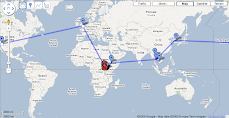
Around the World in 68 Days

Number of different countries visited: 8
Number of days it took to circle the globe: 68
Total miles flown: 23,374
Actual hours in the air: 40
Hours spent waiting in airports: 24
Number of different airlines flown: 5
Number of hours spent on buses: 10
Number of hours spent on trains: 26
Number of complimentary in-flight bottles of wine consumed: 7
Number of my bags stolen: 1
Number of bribes taken: 2
Number of times hospitalized: 1
Number of different languages I tried to communicate in: 5
Number of times I feared for my life: 2
Number of friends made: Too many to count
I'll be honest with you, after thinking long and hard I have decided that there is no way that I can sum up my trip around the world in words. I honestly wouldn't know what to write. So I think I will sum it up with something I wrote on the back page of my journal as I sat on a boat taking me across the crystal waters of the Gulf of Thailand.
"What is left to say.
The Sun rose every day despite what I had seen the day before.
I helped a lot of people, a lot of people helped me.
I saw the danger of human desire, I saw the beauty of human altruism.
I struggled with despair, I clung to hope.
What I saw made me sick, sometimes it made me cry.
I was afraid for my life, and I stared fear in the eyes.
Sometimes I ran, others I stood.
I was faced with decisions each day, decisions that built me up, and broke me down.
I was asked all the while what it was I really believed about the world.
And I was afraid that my answer would cause me to lose hope.
I haven't lost it yet."
Tuesday, March 3, 2009
The Honest Traveler

I am in Korea now, but to be honest I’m not sure where my heart is. I keep asking myself, did I leave it somewhere on the dirt streets of Africa? On the white sandy shores of Koh Chang Island? In the jungles in the far north of Chaing Mai, Thailand? I’m not sure.
To be honest with you I have been struggling with a lot lately. This is for another blog, no doubt, but suffice it to say I have been asking questions that are fairly fundamental to living, questions involving how to live, or rather, why to live. It’s a loss of innocence, I suppose. One cannot circle the globe without experiencing it, unless they have lost touch with themselves. The truth is there a certain darkness to the world that we live outside of for the most part, a cruel, wicked thing that preys on our weakest elements. It’s the kind of thing that we are more inclined to believe in when we are young, more perceptive and enraptured by fairy tales. Every child who has ever heard his parents arguing knows it exists. And people analyze the problems that so plague this world and blame them on things like violence on television, socio-economic status, and the like. But the truth as I see it is quite simple really, and this truth has been central to my development as I have traveled; mankind is dark, and I include myself in that statement.
There were times during my travels through Africa when I fundamentally questioned the goodness of people. In fact most of my time there I did. When you are hissed at in the streets, yelled at by the ignorant and thankless, when you see families destroyed and meet survivors of incredible travesty, when you hear of 150 innocent people burned to death in a church miles from your home at the hands of a militia fighting “for God,” it's enough to make you question everything. I think there is a point, at least one that I reached, where simple answers don’t suffice. I couldn’t blame the problems I saw on “a few bad apples,” no, the problems in Africa and in Thailand are endemic of a much greater issue: the issue of man’s selfish and violent inhumanity to man.
In Thailand I was beaten by two drunken Thai men who were out for blood, nothing else. I had done nothing to provoke them, I was guilty of nothing but defending my friend, a good man. And there is a point that I came to when I realized that there is a hatred and an anger that is so reckless and irrational there is nothing rational people can do to stop it. Reason will fail you, as it failed me. So what do you do when reason fails? When hope hangs from a string? How do you react to the unpleasant fact that wickedness and evil are far more rampant than you ever realized? These are questions I fear the answers to.
Two days ago I arrived home to Korea, a few hours later I received a phone call that my 19 year old little brother, whom I love with every facet of my being, was in a car accident and thrown from his vehicle onto the street. The car that hit him drove away and hasn’t been found. He will recover, but it will be long and difficult.
So I ask again, what do you do when reason fails?
I really don’t have time nor do I want to jump further into this issue now, I just wanted to share a bit of what I saw and came to understand. I will write more later, but I don’t want you to read this and get the wrong idea, let me tell you, humanity is worth something. I’m not sure how much, but the very fact that there is so much darkness proves that there is light. And how sweet that light is, if only I could spread it.
I have been listening to Jon Foreman’s song “Equally Skilled.” I think it is true, and it summarizes a bit of how I feel. Listen to it sometime if you can, in the meantime I will leave you with the lyrics:
How miserable I am
I feel like a fruit picker who arrives after the harvest
There's nothing here at all
Nothing at all here that could placate my hunger
The godly people are all gone
There's not one honest soul left here on the planet
We're all murderers and thieves
Setting traps here for even our brothers
And both of our hands
Are equally skilled
At doing evil
Equally skilled
At bribing the judges
Equally skilled
At perverting justice
Both of our hands
Both of our hands
The day of justice comes
And is even now swiftly arriving
Don't trust anyone at all
Not your best friend or even your wife
For the son hates the father
The daughter despises even her mother
Look! Your enemies are right
Right in the room of your very household
And both of their hands
Are equally skilled
At doing evil
Equally skilled
At bribing the judges
Equally skilled
At perverting justice
Both of our hands
Both of our hands
No, don't gloat over me
For though I fall, though I fall
I will rise again
Though I sit here in darkness
The Lord, the Lord alone
He will be my light.
I will be patient as the Lord
Punishes me for the wrongs I've done against Him
After that He'll take my case
Bringing me to light and to justice
For all I have suffered
And both of His hands
Are equally skilled
At ruining evil
Equally skilled
At judging the judges
Equally skilled
At administering justice
Both of His hands
Both of His hands
Are equally skilled
At showing mercy
Equally skilled
At loving the loveless
Equally skilled
At administering justice
Both of His hands
Both of His hands
Tuesday, February 24, 2009
Sanyu and Leaving Africa

It seems that a bit of time has gone by since I last posted here; its only been about two weeks, but I have found that when you are traveling a lifetime of experience can pack its way into such a small space of time. Em and I spent all of our last week in Africa at Sanyu Babies Orphanage in the middle of Kampala, the capital of Uganda. Our time there was really amazing, and I found that I derived much more joy from hanging out with infants than I thought I would. Each kid had a unique personality that never ceased to amaze me. Some were quiet, most were loud. Some liked to play with their friends, most liked to hit their friends. Emily and I ran the morning preschool class with about 20 toddlers, and it didn’t take long for a few of them to establish a sort of “fight club” that involved them taking any toy they could and hitting their friends in the head. Keep in mind that these kids couldn’t walk. As hilarious as it was to watch these kids turn lettered blocks into weapons, inevitably I had a responsibility to keep the peace, and that is what I tried to do. Feeding time was the second craziest time of the day, we had all 40 kids lined up in small wooden chairs and had the enormous responsibility of hand feeding most of them some kind of mashed sweet potato. What little they didn’t either throw at me or drop down their shirts they seemed to enjoy immensely. The most difficult event of the day was bath time. Oh my goodness it was insanity. The kids all stripped down and one by one, stood in a line and were each taken by a large, serious looking African nurse and scrubbed mercilessly in a small tub of water. After this scrubbing they would emerge smiling and usually laughing and run towards me as I waited with a towel in hand. Drying a wriggling African child was such a task that before I could finish one, two more would come and tackle me from either side, drying themselves on my shirt. Before I knew it there were dozens of naked children running wildly around and screaming. I would chase them around the concrete floored room trying to grab them, and would eventually give up. Of course after this insanity we would have to change diapers (yes, I changed my first diaper there, and many more after it,) dress them and put them in their cribs. Wow. The whole process took about an hour and a half and by the time we were done we were exhausted and full of stories about the rambunctious children. It was really an amazing time, and saying goodbye to those kids was far more difficult than I had anticipated.
On the way out of the airport in Uganda I experienced one last touch of African “realities,” if you want to call it that. I had a 7-hour wait at Entebbe airport in Uganda before my flight on Ethiopian Airlines left. When I finally was able to check my bags the airport employee informed me that my bags were about 10kg over the allowed weight. He shook his head and said that it was “a large fee” to send my bags, but then said, in almost a whisper “I want to help you.” “Ok” I thought, but how could he do that when my bags were clearly over weight? There was an awkward silence for a few seconds while we each stared blankly at each other, until he said again, this time slower and even quieter, “I want to help you.” Aaaaaah. I began to think African and understood what he was implying. “So” I said, unsure as to how to proceed, “you want….money?” He nodded. “Like, this much money?” I said cautiously pulling a 5,000 shilling note out of my pocket. Without saying a word he quickly swiped it from my hand and shoved it into his pocket. So, to make a long story short he demanded 5,000 more but said that his manager was watching so he would find me later and collect it from me then. I still had three hours to wait at the time so I proceeded to hide myself from him as best as I could. Finally it was time to board and I thought I had successfully thwarted the money making plans of this corrupt airport employee. As I was about to step onto the plane to my dismay I saw the man emerge from inside the plane and walk straight towards me. I was surrounded by people at the time and curious as to what he was going to do. He waked up to me and asked me for my ticket, shooting me a demanding glance. Slowly I pulled the ticket from my pocket along with a 1,000 shilling note and handed them to him. He took the money quickly and said in a whisper “This is all?” I knew I had the upper hand because there was no way he could ask for more money in the position he was in so I didn’t say a word, I just shrugged.
So that is how I left Africa, with a parting reminder that there is a lot that needs to change. Any kind of sustainable change will have to take place first in the minds and hearts of people who are willing to change the culture of corruption and dare to believe in honesty and truth. It’s really a bold thing, if you think about it.
Sunday, February 8, 2009
Entebbe Again, Monkeys, Tarzan, and Ants

Back in Entebbe, Uganda, and this time it's quite a different feeling. I am used to the sights, the smells, the overwhelming nature of this place, so it's a little easier to take in.
We are staying at the Airport Guesthouse, which is literally an oasis in the desert. It is nicer than most hotels I have stayed at in the States, and for Uganda, that is saying a lot. We have HOT WATER showers, good food, and ice cream for dessert! That will all end tomorrow as we head to Kampala for a tour of the Watoto Villages, and then on to Sanyu Orphanage where we will work for the next week.
A brief highlight of the last 48 hours: Today we went to the Entebbe Botanical Gardens, which was an incredible place full of huge trees, and giant vines hanging overhead. Our guide proudly told us that it was here that the 1930s Tarzan movie was filmed. I believed it, so much so that I grabbed a huge vine and swung 15 feet into the air. It was incredible. I let out a quick Tarzan-esq yell, and, after thumping my chest a few times, we moved on.

We came to a series of trees around which over 150 monkeys were playing and jumping around. It was amazing, they had almost no fear of humans so we could walk within two feet of them without disturbing them at all. There is something so freeing about watching them play, jumping from tree to tree flying through the air.
Unfortunately for me, in my ever-continuing quest for taking quality pictures, I ventured a little too far off the beaten path into some brush. As I was snapping a few pictures I felt several pricks on my feet, I looked down and saw dozens of giant ants covering my feet. It was the wrong day to opt for sandals. I had stopped directly on an ant hill to take my pictures, and in no more than ten seconds they had crawled up my legs and all over my body. It was one of the worst feelings I have ever had, it felt like my body was crawling. I ran toward Emily and our guide, trying hard to keep my cool but desperately swatting at the creatures that now covered my body. I knew I was in trouble when the guide looked worried and said, "oh dear, you might have to strip down." No way was I about to strip down naked in the middle of the Entebbe Botanical Gardens, so as he said this I started swatting furiously at the little beasts; smashing, clawing, pinching, slapping, doing anything I could to rid myself of this plague. Emily and the guide joined in as I danced around flailing my arms and shaking my jeans. So much for keeping my cool. Eventually all of the creatures were either dead and stuck in my leg hair and jeans, or on the ground. The guide, after examining the fallen ants remarked casually, "ah, these are safari ants, thank goodness, not poisonous." "Whew," I thought. "That was close." It was an experience, one that I sincerely hope never ever to have again.
Wednesday, February 4, 2009
Baptism and a Feast

“You have been baptized!” said the grinning Congolese man as he entered my room. “Now that you have Malaria you are Congolese!” As he said this I wished I could share the same enthusiasm regarding my illness, but there was no denying it, I had been baptized in the waters of African disease, and I could now relate to the plight of the Congolese in a new way. I was tested a few days ago for Malaria and came up positive for not only Malaria, but also Salmonella poisoning, which explained why my insides were burning. I walked out of Maba-Conga Clinic with three new prescriptions and a promise from the friendly doctor that I would be feeling better soon. “Asante-Sana” (thank you in Swahili) was about all I could eek back. Thankfully, this disease has not debilitated me to the point of not being able to teach or do other important things like eat. To be honest the Salmonella has been far worse than Malaria, although one might guess the opposite to be true. Anyway, I should be cured within the week, and even now I have almost no lingering side effects from the sickness. In related news, Emily and I seem to be in a contest to see who can be sicker, and just after I one-upped her Malaria with my Salmonella/Malaria combo, she came down with Typhoid fever. It turns out she still has Malaria but has picked up a bit of a bonus with the Typhoid. Nice job. Hopefully my body won’t feel the need to one-up that.
Many other exciting things have been happening. I will try to do justice to a few of these events quickly:
The Superbowl was a few nights ago and, since the Cardinals were playing, we weren’t about to let a few thousand miles and a huge time difference keep us from watching it. To begin the celebration we decided to try to make tortilla chips and guacamole and subsequently spend the majority of the afternoon operating a kind of chip-making assembly line. Bethany, Luke, and Justin, the other three Americans here, all helped. Bethany made the dough and rolled it, I cut the dough into chip-looking pieces and handed them to Justin and Luke who fried them in a skillet. Emily threw on a bit of salt and before we knew it we had a few hundred chips ready to be enjoyed. The game didn’t begin until 1:30am our time, so we all went to bed at our usual time of 10pm, and woke up at 1am to begin the festivities. We had soda (actually cold from the fridge!) chips and guacamole, and a whole lot of team spirit. Unfortunately, most of you know the outcome of the Cardinals ill-fated quest for the Superbowl title, but what a game! Our little battery operated television actually lasted all four hours, and we went to bed at about 5am, only to wake up at 7 for English classes the next day. It was probably the best Superbowl party I have ever been to.
One of my favorite students, Amani, was involved in an accident on his way to a town called Butembo, a few miles south of here. He was in the back of a truck carrying close to 70 people that, while trying to make a sharp turn, drove off of a cliff and rolled several times. 38 people died. 38. And Amani was one of the few who survived with only minor injuries, he was back in class a few days ago and is a living-breathing miracle. Just watching him walk around and talk and smile and speak of God’s goodness is deeply moving. I learn so much from my students; I have learned the most from him.
A thunderstorm hit Beni yesterday that was the biggest I had ever seen. Dr. Kasali (whose home we are staying in) said, with a dire look on his face, “tropical rains, not a good thing.” He was right, the gates to our little compound flew open, the chickens and various animals living inside all screamed and squawked and ran in terror, the rain poured, the wind blew, and within 15 minutes our house was flooded with an inch of water. We spent the next few hours trying to soak up what we could and salvage those things that had been on the floor. It was wild; living in Arizona has not provided me with any experiences close to that.
Two days ago Emily and I took a trip to a Leprosy Camp in the nearby town of Oicha, we spent all day there and to say that it was a moving experience wouldn’t come close. First of all, let me say that until recently I was under the impression that Leprosy was a disease from Biblical times; an interesting sounding debilitation used conveniently for conveying poignant moral lessons. I had no idea that it was, in truth, a brutal disease that ravages people’s bodies and leaves them debilitated, helpless, and often deserted by their families and remains alive and well in most poor countries. The director greeted us and took us on a tour of the Camp, allowing us a chance to visit with and get to know some of the lepers living there. Seeing firsthand the effects of an illness that so altered the appearance of its victims was remarkable and profound, and to see the indomitable spirit of most of the residents was encouraging to say the least. The smiles I received from those with missing arms, legs, eyes, fingers, toes and teeth were enough to give me hope that life might be much simpler than I had imagined. After spending some time with the patients, we were told that the camp only had enough food to supply the patients with one meal daily, some beans and bananas, and that due to these realities most are often hungry. After hearing this we had an idea and asked the director if we might be able to buy the camp a meal, something nice, (by third-world standards.) The director was overjoyed at the prospect and hurriedly assigned two of his helpers to accompany us to the local market to buy the necessary ingredients. An hour later we returned carrying several pounds of meat, a huge bag of rice and ten head of cabbage. Emily and I tried to help with the preparation by cutting the cabbage, (a skill at which I am terrible,) and had our inefficiency consistently laughed at by the women who usually take on the cabbage cutting responsibility. Finally, after two hours of preparation we were able to serve the patients a meal, and it was incredibly rewarding. Each one cried out “Asante-Sana! Asante!” and shook our hands with whatever fingers still remained on their hands. To them this simple meal of cabbage, meat and rice was a feast, and I have to admit, as we sat down with the director of the Camp and his helpers for our meal, eating with our hands because of the lack of silverware, it did feel an awful lot like a feast.
Subscribe to:
Posts (Atom)